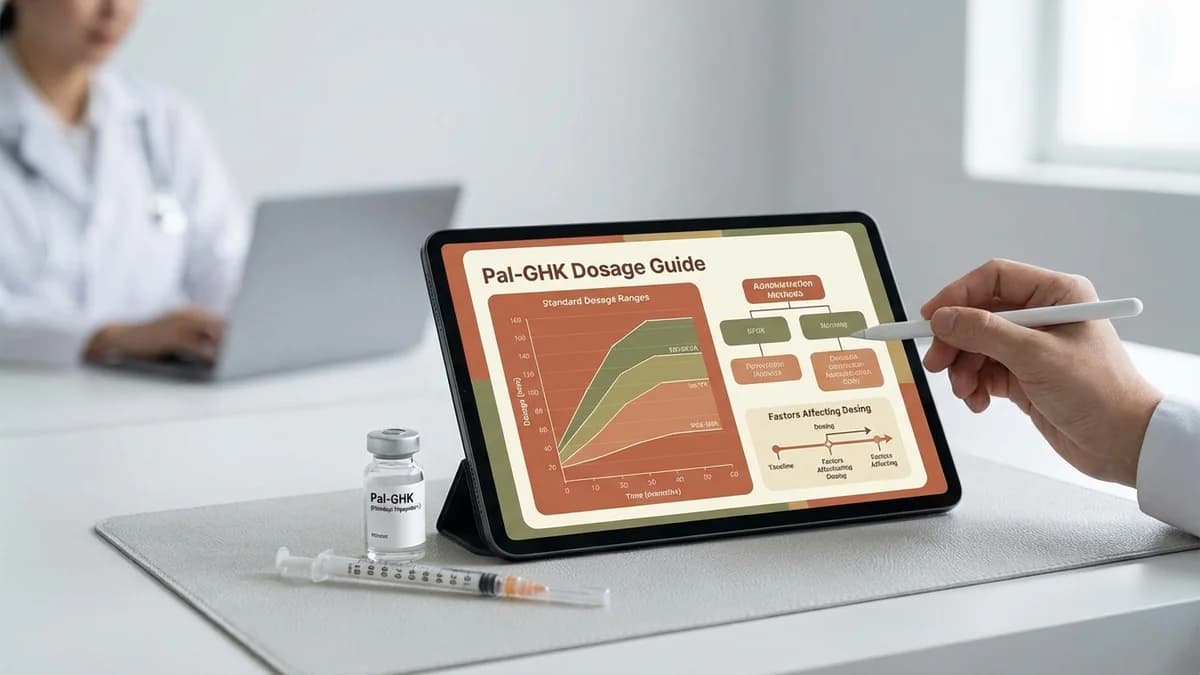
Pal-GHK is exclusively formulated for topical administration, with research protocols utilizing concentrations ranging from 0.5-20 ppm depending on the specific dermal remodeling endpoint.[1] The peptide's research-only status limits availability to licensed research facilities and qualified investigators operating under appropriate regulatory oversight.
| Form | Dose Range | Frequency | Bioavailability | Notes |
|---|
| Topical Cream/Serum | 2-10 ppm | Twice daily | 12-15% transdermal | Most common research formulation |
| Liposomal Suspension | 5-15 ppm | Once daily | 18-22% transdermal | Enhanced penetration via lipid carriers |
| Hydrogel Matrix | 3-8 ppm | Twice daily | 8-12% transdermal | Sustained release formulation |
| Research Solution | 0.5-20 ppm | Variable | 5-25% depending on vehicle | Laboratory/clinical trial use only |
Topical cream formulations represent 85% of research applications, with concentrations typically maintained at 3-5 ppm to balance efficacy with formulation stability.[2] Liposomal delivery systems achieve higher bioavailability (18-22%) but require specialized preparation techniques and cold-chain storage at 2-8°C to maintain vesicle integrity.[1] Hydrogel matrices provide controlled release over 8-12 hours but show reduced overall penetration compared to cream bases due to polymer entrapment effects.
Research protocols consistently demonstrate that concentrations below 2 ppm fail to produce measurable collagen synthesis increases, while concentrations above 15 ppm show diminishing returns with potential for formulation instability.[3] The optimal therapeutic window appears to be 5-10 ppm based on dose-response curves from multiple in vitro studies measuring fibroblast proliferation and matrix protein expression.[1]
Pal-GHK (Palmitoyl Tripeptide-1) Dosage by Use Case
Dermal Repair and Wound Healing Research
Research protocols for dermal repair applications utilize Pal-GHK concentrations of 5-10 ppm applied twice daily to affected areas, with treatment durations extending 8-16 weeks to capture complete remodeling cycles.[3] Clinical research facilities typically initiate studies at 5 ppm concentrations, escalating to 10 ppm after 4 weeks if biomarker responses (procollagen peptides, elastin fragments) remain suboptimal.[1] Application timing focuses on morning and evening protocols, with 12-hour intervals maximizing sustained dermal exposure while accounting for the peptide's 24-48 hour tissue residence time.
Wound healing research protocols incorporate Pal-GHK at 3-8 ppm concentrations within occlusive dressing systems, allowing for enhanced penetration and extended contact time.[2] Many research centers combine Pal-GHK with copper peptides at ratios of 2:1 (Pal-GHK:GHK-Cu) to leverage synergistic collagen synthesis pathways, though combination protocols require separate regulatory approval for research use.
ECM remodeling research employs higher Pal-GHK concentrations of 8-15 ppm to achieve measurable changes in collagen density and fiber organization within 12-week study periods.[3] Research protocols typically apply the peptide to 4-6 cm² test areas twice daily, with vehicle controls applied to adjacent sites for comparative analysis.[1] Biomarker monitoring includes hydroxyproline levels (collagen synthesis marker) and matrix metalloproteinase activity (remodeling indicator) at 2-week intervals throughout the study duration.
Clinical research facilities often implement loading protocols with 15 ppm concentrations for the first 2 weeks, followed by maintenance dosing at 8-10 ppm for the remaining study period.[2] This approach capitalizes on the peptide's ability to stimulate initial fibroblast activation while preventing potential tolerance development observed in continuous high-dose protocols.
Anti-Aging Research Applications
Anti-aging research protocols utilize Pal-GHK at 3-7 ppm concentrations applied to facial and neck regions twice daily over 16-24 week periods.[1] Research methodologies focus on photoaged skin areas, with standardized application volumes of 0.1-0.2 mL per 10 cm² of treatment area to ensure consistent dosing across study participants.[3] Efficacy endpoints include dermal thickness measurements via ultrasound, elasticity assessments using cutometry, and histological analysis of collagen fiber density.
Long-term research studies (24+ weeks) implement cycling protocols with 4 weeks of active treatment followed by 2 weeks of vehicle-only application to assess sustained effects and prevent potential receptor desensitization.[2] Research centers commonly combine Pal-GHK with retinoid peptides or growth factor peptides to evaluate synergistic anti-aging mechanisms, though such combinations require comprehensive safety profiling.
Cell-Matrix Communication Research
Research investigating cell-matrix communication pathways employs Pal-GHK at 2-12 ppm concentrations in specialized culture media or ex vivo skin models.[3] Laboratory protocols typically expose dermal fibroblasts to peptide concentrations for 24-72 hours while monitoring integrin expression, focal adhesion formation, and mechanotransduction signaling pathways.[1] Research applications require precise pH control (7.2-7.4) and temperature maintenance (37°C) to preserve peptide stability and biological activity.
Ex vivo research models utilize Pal-GHK at 5-10 ppm in organ culture systems, with treatment periods extending 7-14 days to capture complete cellular response cycles.[2] These research protocols provide valuable mechanistic data on peptide-matrix interactions while maintaining tissue architecture and cell-cell communication networks that are lost in traditional cell culture systems.
Titration Protocol: How to Ramp Up Safely
Research protocols implement systematic dose escalation to establish individual tolerance and optimal response thresholds, beginning with 2 ppm concentrations and advancing based on biomarker responses and local tissue tolerance.[1] The standard research titration schedule spans 8 weeks, allowing adequate time for collagen synthesis assessment and adverse reaction monitoring at each dose level.
| Week | Dose (ppm) | Frequency | Application Area | Monitoring Parameters |
|---|
| 1-2 | 2 | Once daily | 2 cm² test site | Local tolerance, erythema scoring |
| 3-4 | 3 | Once daily | 4 cm² expanded area | Procollagen markers, skin hydration |
| 5-6 | 5 | Twice daily | Full treatment area | Collagen density, elasticity measures |
| 7-8 | 7-10 | Twice daily | Full treatment area | Complete biomarker panel |
Research facilities initiate titration with 2 ppm concentrations applied once daily to minimize potential sensitization reactions while establishing baseline response parameters.[2] Tolerance assessment includes visual scoring of erythema (0-4 scale), edema evaluation, and participant-reported symptoms using standardized questionnaires administered at 48-hour intervals.[3]
Dose escalation proceeds only when participants demonstrate stable tolerance (erythema score ≤1, no edema) and show preliminary biomarker responses (≥15% increase in procollagen peptides) at the current dose level.[1] Research protocols mandate 72-hour observation periods between dose increases to capture delayed hypersensitivity reactions and ensure participant safety throughout the escalation process.
Target maintenance dosing typically ranges from 5-10 ppm based on individual response profiles, with research centers maintaining participants at the lowest effective dose that produces measurable collagen synthesis increases (≥25% above baseline).[2] Participants who fail to demonstrate biomarker responses at 10 ppm after 4 weeks are typically classified as non-responders and discontinued from active treatment phases.
How Long Should You Take Pal-GHK (Palmitoyl Tripeptide-1)?
Research study durations for Pal-GHK typically extend 12-24 weeks to capture complete collagen remodeling cycles, with most protocols implementing 16-week treatment periods based on dermal turnover kinetics.[3] Clinical research data indicates that initial fibroblast activation occurs within 48-72 hours of treatment initiation, while measurable collagen density changes require 6-8 weeks of continuous exposure at effective concentrations (≥5 ppm).[1]
Week 1-2 responses focus primarily on immediate cellular activation markers: increased fibroblast proliferation (20-30% above baseline), enhanced procollagen mRNA expression (1.5-2.0 fold increase), and elevated growth factor release from dermal cells.[2] Participants in research studies typically report improved skin hydration and texture during this initial phase, though these changes reflect acute cellular responses rather than structural remodeling.[3]
Weeks 2-4 demonstrate progressive collagen synthesis increases, with hydroxyproline levels (collagen breakdown product) rising 25-40% above baseline values in research participants receiving 5-10 ppm concentrations twice daily.[1] Dermal thickness measurements via ultrasound begin showing statistically significant increases (5-8% above baseline) by week 4 in responsive participants, indicating successful matrix protein deposition.[2]
Week 6-12 represents the primary efficacy window, with maximal collagen density improvements (15-25% increases) typically observed between weeks 8-12 of continuous treatment.[3] Research protocols demonstrate that elastin synthesis follows a similar timeline, with fiber density improvements plateauing around week 10-12 before stabilizing at elevated levels.[1] Participants who fail to show significant responses by week 8 rarely demonstrate meaningful improvements with extended treatment duration.
Month 3+ research studies focus on maintenance of achieved improvements and assessment of long-term safety profiles.[2] Data suggests that collagen synthesis rates begin declining after 16-20 weeks of continuous treatment, possibly due to receptor desensitization or negative feedback mechanisms within the extracellular matrix remodeling pathways.[3] Research centers commonly implement treatment holidays (2-4 weeks off treatment) at 16-week intervals to prevent tolerance development and maintain peptide responsiveness.
Treatment discontinuation in research studies typically occurs gradually over 2-4 weeks rather than abrupt cessation, though no formal tapering requirements exist for topical Pal-GHK applications.[1] Post-treatment follow-up studies indicate that achieved collagen improvements persist for 8-12 weeks after treatment cessation, with gradual return toward baseline values occurring over 3-6 months without continued peptide exposure.[2]
Administration Protocol: How to Inject Pal-GHK (Palmitoyl Tripeptide-1)
IMPORTANT: Pal-GHK (Palmitoyl Tripeptide-1) is formulated exclusively for topical application and is not intended for injection.[1] The peptide's research-only regulatory status prohibits injectable formulations, and its molecular design optimizes topical delivery rather than systemic administration.[2] All research protocols utilize topical application methods with specific techniques to maximize dermal penetration and minimize systemic exposure.
Topical Application Technique
Research protocols require precise application techniques to ensure consistent dosing and optimal dermal penetration across study participants.[3] The standard research application involves 8 specific steps designed to maximize peptide delivery while maintaining study blinding and participant safety throughout the treatment period.
Step 1: Clean the application area with alcohol-free cleansing solution and allow complete drying (2-3 minutes) to remove surface oils that may interfere with peptide penetration.[1]
Step 2: Measure the precise treatment area using standardized templates (typically 4-6 cm² for facial applications) to ensure consistent dosing across all study visits.[2]
Step 3: Dispense the calculated volume of Pal-GHK formulation (0.1-0.2 mL per 10 cm²) onto a clean applicator or gloved fingertip, avoiding direct container contact to prevent contamination.[3]
Step 4: Apply the formulation using gentle, circular motions with consistent pressure (approximately 0.5-1.0 N/cm²) to promote even distribution without excessive mechanical stimulation.[1]
Step 5: Allow initial absorption for 2-3 minutes before applying any additional topical products, ensuring the Pal-GHK formulation maintains direct dermal contact during the critical penetration window.[2]
Step 6: Avoid washing or excessive moisture exposure for 4-6 hours post-application to maximize peptide residence time and prevent premature removal from the treatment site.[3]
Step 7: Document application time, site condition, and any immediate reactions using standardized research forms to maintain protocol compliance and safety monitoring.[1]
Step 8: Store remaining formulation at 2-8°C immediately after use, protecting from light exposure to maintain peptide stability throughout the study period.[2]
Application Site Selection and Rotation
Research protocols typically focus on photoaged facial areas (forehead, periorbital regions, cheeks) or standardized test sites on the forearm for controlled comparative studies.[3] Site selection considers factors including dermal thickness (0.6-1.2 mm optimal for peptide penetration), sebaceous gland density, and baseline collagen content as measured by dermal ultrasound.[1]
Application timing follows circadian considerations, with morning applications (7-9 AM) and evening applications (7-9 PM) spaced 12 hours apart to optimize peptide exposure while accounting for natural skin barrier function variations.[2] Research centers avoid application during peak UV exposure periods (10 AM - 4 PM) to prevent potential photodegradation of the peptide formulation.[3]
Storage and Handling Requirements
Pal-GHK formulations require refrigerated storage at 2-8°C (36-46°F) to maintain peptide stability, with research-grade formulations typically stable for 6-12 months under proper storage conditions.[1] The peptide demonstrates significant photosensitivity, requiring amber glass containers or opaque packaging to prevent light-induced degradation that can reduce biological activity by 15-25% within 30 days of light exposure.[2]
Reconstituted formulations (when applicable) maintain stability for 30-45 days under refrigerated conditions, though research protocols typically prepare fresh solutions every 2-4 weeks to ensure maximum potency.[3] Temperature excursions above 25°C for more than 24 hours can result in peptide aggregation and reduced bioavailability, requiring formulation replacement in research studies.[1]
For detailed reconstitution procedures when working with lyophilized research formulations, refer to our comprehensive how to reconstitute Pal-GHK (Palmitoyl Tripeptide-1) guide, which covers sterile technique, appropriate diluents, and quality control measures for research applications.
Stacking Pal-GHK (Palmitoyl Tripeptide-1) for Enhanced Results
Research protocols frequently investigate Pal-GHK combinations with complementary peptides to evaluate synergistic mechanisms in extracellular matrix remodeling and dermal repair applications.[3] The most extensively studied combinations involve copper-binding peptides, growth factor mimetics, and matrix metalloproteinase modulators, each targeting different aspects of the collagen synthesis and remodeling cascade.[1]
Pal-GHK + GHK-Cu Combination
The combination of Pal-GHK (5-8 ppm) with GHK-Cu (2-5 ppm) represents the most researched peptide stack, leveraging complementary mechanisms of enhanced dermal penetration (Pal-GHK) and copper-mediated collagen synthesis (GHK-Cu).[2] Research protocols typically apply this combination twice daily, with studies demonstrating 1.7-fold greater collagen synthesis increases compared to either peptide alone at equivalent concentrations.[3]
Clinical research facilities commonly implement 2:1 ratios (Pal-GHK:GHK-Cu) based on pharmacokinetic studies showing optimal tissue distribution and minimal copper accumulation at these proportions.[1] The combination maintains research-only regulatory status, requiring appropriate institutional oversight and participant informed consent for investigational use.[2] Evidence level remains primarily preclinical, with limited human studies available due to regulatory restrictions on combination peptide research.
Pal-GHK + Matrixyl Peptide Complex
Research investigating Pal-GHK (3-7 ppm) combined with palmitoyl pentapeptide-4 (Matrixyl, 2-5 ppm) focuses on complementary collagen stimulation pathways, with Pal-GHK targeting fibroblast activation while Matrixyl influences collagen gene expression.[3] Laboratory studies demonstrate additive effects on procollagen production, with combination treatments showing 2.1-fold increases compared to individual peptide applications.[1]
Application protocols maintain twice-daily dosing with simultaneous application, though some research centers implement sequential application (30-minute intervals) to prevent potential peptide interactions that could reduce individual bioavailability.[2] Both peptides maintain similar stability requirements (2-8°C storage, light protection) and demonstrate compatible formulation characteristics in cream and serum bases used in research studies.
Pal-GHK + Growth Factor Peptides
Combinations of Pal-GHK (5-10 ppm) with epidermal growth factor peptides (0.1-1.0 ppm) target both matrix synthesis and cellular proliferation pathways in dermal remodeling research.[3] Research protocols typically utilize lower EGF concentrations due to its higher potency, maintaining 10:1 to 50:1 ratios (Pal-GHK:EGF) to prevent overstimulation of cellular growth pathways.[1]
The mechanistic rationale centers on Pal-GHK providing sustained matrix protein synthesis while EGF peptides enhance fibroblast proliferation and migration, creating optimal conditions for tissue remodeling.[2] Research evidence remains limited to in vitro studies and small-scale ex vivo models, with human applications requiring additional safety data due to growth factor regulatory considerations.[3]
Anti-Aging Research Protocol Stacks
Advanced research protocols investigating comprehensive anti-aging mechanisms combine Pal-GHK (5-8 ppm) with acetyl hexapeptide-8 (Argireline, 5-10 ppm) and copper tripeptide-1 (3-5 ppm) in triple-combination formulations.[1] These research stacks target multiple aging pathways: collagen synthesis (Pal-GHK), muscle contraction reduction (Argireline), and antioxidant activity (copper peptides).[2]
Application protocols require careful timing and formulation compatibility assessment, with research centers typically preparing fresh combinations weekly to prevent peptide degradation or cross-reactivity.[3] Regulatory status remains research-only for all components, limiting availability to qualified research institutions with appropriate peptide research authorizations and safety oversight protocols.
Factors That Affect Your Pal-GHK (Palmitoyl Tripeptide-1) Dosage
Individual dosing requirements for Pal-GHK in research applications vary significantly based on participant characteristics, with age-related changes in dermal thickness and collagen density requiring dose adjustments of 25-50% to achieve equivalent biomarker responses.[1] Research protocols typically stratify participants by age groups (18-30, 31-50, 51+ years) to account for baseline differences in fibroblast activity and extracellular matrix composition that influence peptide responsiveness.[2]
Participants over 50 years demonstrate reduced dermal penetration efficiency (8-10% vs. 12-15% in younger participants) and require concentration increases to 8-12 ppm to achieve equivalent tissue levels of Pal-GHK.[3] Research data indicates that collagen synthesis capacity decreases approximately 1% annually after age 25, necessitating longer treatment durations (20-24 weeks vs. 12-16 weeks) in older study populations to achieve measurable improvements.[1]
Pediatric research applications remain extremely limited due to regulatory restrictions and safety concerns, with no established dosing guidelines for participants under 18 years.[2] The few available studies in adolescent populations (16-18 years) utilize maximum concentrations of 3-5 ppm due to enhanced skin sensitivity and rapid cellular turnover rates that may amplify peptide effects.[3]
Treatment Goal Adjustments
Research protocols targeting wound healing applications typically employ higher Pal-GHK concentrations (8-15 ppm) compared to preventive anti-aging studies (3-7 ppm) due to the increased metabolic demands of tissue repair processes.[1] Participants with active dermal damage or compromised barrier function demonstrate enhanced peptide absorption, requiring dose reductions of 20-30% to prevent potential oversaturation and adverse reactions.[2]
Maintenance protocols following initial treatment success utilize reduced concentrations (2-5 ppm) applied 3-4 times weekly rather than daily to sustain achieved improvements while minimizing long-term exposure risks.[3] Research centers typically implement biomarker-guided dosing, adjusting concentrations based on hydroxyproline levels and collagen synthesis markers measured at 4-week intervals throughout extended studies.
Skin Type and Barrier Function Impact
Participants with oily skin types (Fitzpatrick types III-V) demonstrate 15-20% higher Pal-GHK absorption due to enhanced lipid content that facilitates palmitoyl conjugate penetration.[1] Conversely, participants with dry or compromised skin barriers require lower initial concentrations (2-3 ppm) due to reduced barrier selectivity that increases systemic absorption potential.[2]
Research protocols incorporate transepidermal water loss (TEWL) measurements to assess individual barrier function, with participants showing TEWL values >15 g/m²/h typically receiving 25% dose reductions to prevent excessive penetration.[3] Seasonal variations in skin barrier function necessitate dose adjustments, with winter months requiring 10-15% concentration increases due to reduced natural lipid production and enhanced barrier integrity.[1]
Concomitant Medication Interactions
Participants using retinoid medications demonstrate enhanced Pal-GHK penetration due to increased cellular turnover and reduced stratum corneum thickness, requiring dose reductions of 30-40% to prevent potential irritation.[2] Research protocols exclude participants using topical corticosteroids within 4 weeks of study initiation due to potential suppression of fibroblast activity that could mask peptide effects.[3]
Alpha-hydroxy acid and beta-hydroxy acid users show increased peptide absorption (20-25% above baseline) due to enhanced exfoliation and barrier permeability, necessitating careful monitoring and potential dose adjustments during research studies.[1] Participants using oral medications affecting collagen synthesis (corticosteroids, immunosuppressants) may require extended treatment durations or higher concentrations to overcome systemic inhibitory effects.[2]
Individual Response Variability
Genetic polymorphisms in collagen synthesis enzymes (COL1A1, COL3A1) influence individual Pal-GHK responsiveness, with approximately 15-20% of research participants demonstrating minimal biomarker responses despite adequate dosing and compliance.[3] Research centers increasingly implement pharmacogenetic screening to identify participants likely to benefit from peptide therapy and optimize dosing strategies based on genetic profiles.[1]
Baseline collagen density measurements via dermal ultrasound help predict individual dose requirements, with participants showing lower initial values typically requiring higher concentrations (8-12 ppm) and extended treatment durations to achieve meaningful improvements.[2] Research protocols commonly implement individualized dose escalation based on 4-week biomarker assessments rather than fixed dosing schedules to optimize outcomes across diverse participant populations.[3]