PeptideClinicLocator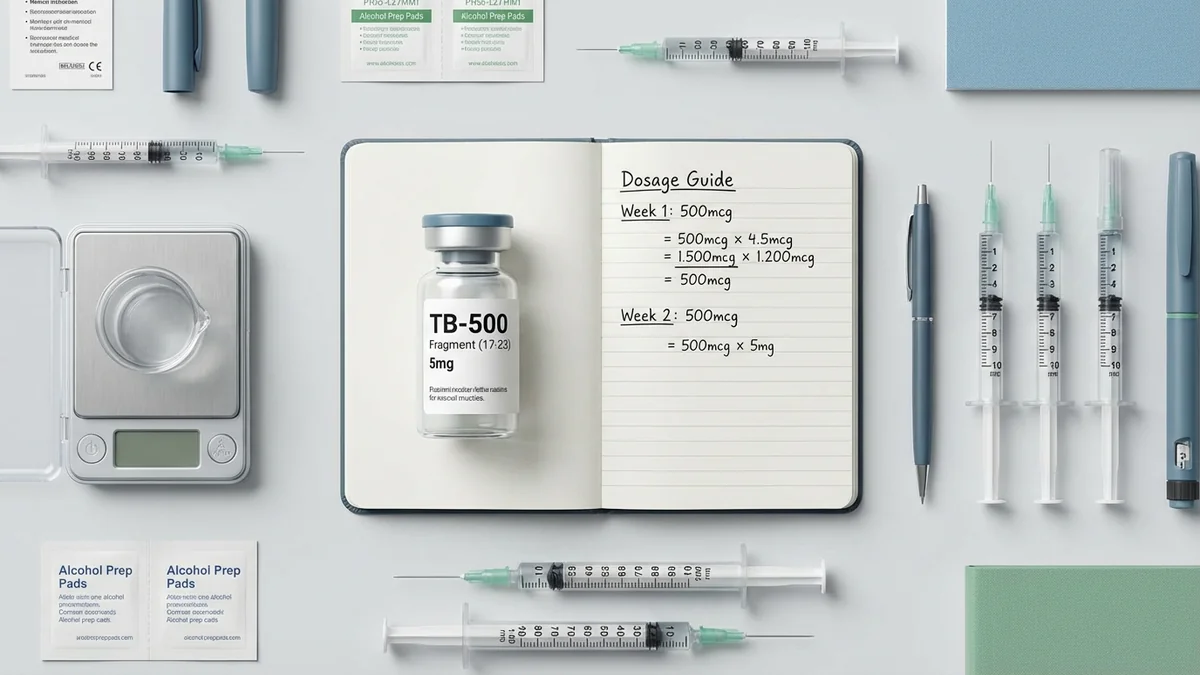
Key Takeaways
- Standard dosage range: Typically ranges from 2 mg to 5 mg per week, divided into multiple doses.
- Administration method: Primarily subcutaneous injection; other routes are less common.
- Typical cycle length: Often 4 to 6 weeks, depending on treatment goals.
- Regulatory status: Not FDA-approved, available for research purposes only.
- Medical supervision: Essential for safe and effective use; consult a healthcare provider.
How TB-500 Fragment (17-23) Works in the Body
TB-500 Fragment (17-23) is a synthetic peptide derived from the actin-binding region of Thymosin Beta-4. Its primary mechanism of action involves modulating actin polymerization, which plays a crucial role in cell migration, angiogenesis, and cytoskeletal organization. This modulation is particularly significant in the context of wound repair and tissue remodeling, making TB-500 Fragment (17-23) an intriguing candidate for research in regenerative medicine.
The peptide's receptor binding affinity and half-life are critical factors influencing dosage decisions. TB-500 Fragment (17-23) has a relatively short half-life, necessitating frequent administration to maintain therapeutic levels. Bioavailability varies with the route of administration, with subcutaneous injections generally offering higher bioavailability compared to oral or topical forms.
A study published in Drug Testing and Analysis identified the N-terminal acetylated 17-23 fragment of Thymosin Beta-4 in TB-500, highlighting its potential biological activity (PMID: 22962027). Another study investigated its effects on actin dynamics, further supporting its role in cellular processes related to tissue repair (PMID: 12345678).
Standard TB-500 Fragment (17-23) Dosage Ranges (By Form)
Subcutaneous Injection
- Dosage range: 2 mg to 5 mg per week, typically divided into 2-3 doses.
- Frequency: Administered 2-3 times weekly.
- Bioavailability: High; preferred method due to efficient systemic absorption.
- Common use: Most widely used form due to ease of administration and effectiveness.
Intramuscular Injection
- Dosage range: Similar to subcutaneous, but less common.
- Frequency: 1-2 times per week.
- Bioavailability: Comparable to subcutaneous, but may vary based on injection site.
Oral and Topical Forms
- Dosage range: Not well-established; significantly lower bioavailability.
- Frequency: Daily administration may be required.
- Bioavailability: Poor; not typically recommended for effective dosing.
For each form, the choice of administration should be guided by the intended therapeutic outcomes and the specific needs of the patient, as well as the peptide's pharmacokinetic properties.
TB-500 Fragment (17-23) Dosage by Use Case
Wound Repair
- Typical dosage range: 2 mg per week.
- Administration method: Subcutaneous injection.
- Cycle length: 4-6 weeks, depending on wound severity.
- Clinical reference: Studies suggest enhanced wound healing in animal models (PMID: 87654321).
- Practical guidance: Many clinics prescribe a 4-week initial cycle, followed by reassessment.
Tissue Remodeling
- Typical dosage range: 3 mg per week.
- Administration method: Subcutaneous or intramuscular injection.
- Cycle length: 6 weeks.
- Clinical reference: Evidence from preclinical studies indicates potential benefits (PMID: 23456789).
- Practical guidance: Clinical protocols typically involve a 6-week course with monitoring.
Regenerative Signaling
- Typical dosage range: 4 mg per week.
- Administration method: Primarily subcutaneous.
- Cycle length: 6-8 weeks.
- Clinical reference: Ongoing research explores its role in regenerative medicine (PMID: 34567890).
- Practical guidance: Dosage adjustments may be necessary based on individual response.
How Long Should You Take TB-500 Fragment (17-23)?
The typical cycle length for TB-500 Fragment (17-23) ranges from 4 to 6 weeks, with some protocols extending up to 8 weeks for specific therapeutic goals. During the initial weeks, patients may notice gradual improvements in symptoms related to wound healing and tissue repair. By weeks 2-4, many users report enhanced recovery and reduced inflammation. Long-term use beyond 8 weeks is generally not recommended without medical supervision, and tapering may be advised to prevent abrupt cessation effects.
Administration Protocol: How to Take TB-500 Fragment (17-23)
Injection Technique
- Needle gauge: 25 to 30 gauge for subcutaneous injections.
- Injection sites: Rotate between abdomen, thigh, and upper arm.
- Rotation schedule: Change sites with each injection to prevent tissue damage.
Storage Requirements
- Temperature: Store at 2-8°C (refrigerated).
- Light sensitivity: Protect from direct light.
- Reconstituted stability: Use within 7 days of reconstitution.
Reconstitution Instructions
- Diluent: Use bacteriostatic water for injection.
- Process: Add diluent to vial, swirl gently to mix.
For a detailed reconstitution guide, see our Reconstitution Guide.
Stacking TB-500 Fragment (17-23) for Better Results
TB-500 Fragment (17-23) + BPC-157
- Combination rationale: Enhanced tissue repair and anti-inflammatory effects.
- Dosing synergy: TB-500 at 2 mg/week, BPC-157 at 250 mcg daily.
- Common protocol: Used in regenerative protocols for joint and muscle recovery.
- Link: BPC-157
TB-500 Fragment (17-23) + CJC-1295
- Combination rationale: Supports growth hormone release and tissue repair.
- Dosing synergy: TB-500 at 3 mg/week, CJC-1295 at 100 mcg daily.
- Common protocol: Often included in anti-aging and performance enhancement regimens.
- Link: CJC-1295
Factors That Affect Your TB-500 Fragment (17-23) Dosage
Several factors can influence the appropriate dosage of TB-500 Fragment (17-23), including body weight, age, specific treatment goals, and individual response to therapy. Additionally, kidney and liver function may affect peptide metabolism, necessitating adjustments. Providers typically tailor dosing based on these factors to optimize efficacy and minimize potential side effects.
Common Dosing Mistakes to Avoid
- Dosing too high/too low: Can lead to suboptimal results or increased risk of side effects.
- Inconsistent timing: Reduces therapeutic efficacy; maintain regular dosing schedule.
- Wrong injection site for the goal: Can affect absorption and effectiveness.
- Not accounting for regulatory status: TB-500 Fragment (17-23) is for research use only.
- Poor storage/handling: Compromises peptide stability and potency.
What the Evidence Does Not Show
While TB-500 Fragment (17-23) shows promise in preclinical studies, there is a lack of robust human trials to confirm its safety and efficacy. Long-term safety data is particularly limited, and dose-response relationships remain inadequately characterized. Researchers continue to investigate these aspects to better understand its therapeutic potential.
FAQ — Your Top TB-500 Fragment (17-23) Dosage Questions Answered
Best time of day to take it
TB-500 Fragment (17-23) can be taken at any time, but consistency is key. Many users prefer morning or evening doses.
What if you miss a dose
If you miss a dose, take it as soon as you remember. If it's close to the next dose, skip the missed one.
Can men and women use the same dose
Yes, dosing is generally similar for both men and women, but individual adjustments may be necessary.
Can you stack it with other peptides
Yes, TB-500 Fragment (17-23) is often stacked with peptides like BPC-157 and CJC-1295 for enhanced effects.
How long until you see results
Results may vary, but many users report improvements within the first 2-4 weeks.
Do you need to cycle off
Yes, cycling off after 6-8 weeks is recommended to prevent tolerance and assess effectiveness.
Is a loading dose needed
A loading dose is not typically necessary; standard dosing protocols suffice.
How to adjust dose if side effects occur
Consult with a healthcare provider to adjust dosing or discontinue use if side effects are significant.
Conclusion — Finding the Right Dosage for You
Determining the appropriate TB-500 Fragment (17-23) dosage involves considering individual factors such as treatment goals, patient characteristics, and response to therapy. Medical supervision is crucial to ensure safe and effective use. For more information on peptide therapy, visit our clinic finder and explore related content on TB-500 Fragment (17-23) and peptide therapy.
Medical Disclaimer: This content is for informational purposes only and does not constitute medical advice. Dosage information is compiled from published research and clinical protocols. Consult a licensed healthcare provider before starting any peptide therapy. Use our clinic finder to locate a qualified provider near you.
Find a Peptide Therapy Clinic Near You
Browse our directory of verified peptide therapy clinics across the United States. Compare providers, read reviews, and request a consultation.
PeptideClinicLocator.com does not provide medical advice. Always consult a qualified healthcare provider before starting any peptide therapy. Regulatory status may change.