Key Takeaways
- Limited Clinical Evidence: AOD-9604 has completed only Phase IIa trials as of 2002, with no published Phase III efficacy data available[1]
- Research-Only Status: Not FDA-approved for therapeutic use; available exclusively for research purposes under current regulations
- Modest Metabolic Effects: Preclinical studies suggest potential influence on lipid metabolism through β-adrenergic and AMPK pathways[2]
- Unclear Timeline: No established therapeutic timeline due to limited human clinical data beyond early-phase trials
- Individual Variation: Response rates and optimal dosing protocols remain undefined without completed Phase III studies
- Alternative Options: Semaglutide and Tirzepatide offer FDA-approved alternatives with robust clinical evidence
What Is AOD-9604?
AOD-9604 is a synthetic peptide fragment consisting of amino acids 177-191 of the human growth hormone sequence, with a molecular weight of approximately 1,815 Da[1]. The peptide was originally developed by Metabolic Pharmaceuticals for potential obesity treatment, entering Phase IIa clinical trials by February 2002[1]. Its proposed mechanism involves modulation of lipid and glucose metabolism pathways through β-adrenergic receptor interactions and AMPK-related signaling cascades[2].
Currently, AOD-9604 maintains research-only status with no FDA approval for therapeutic applications. The peptide is available exclusively for investigational purposes, distinguishing it from approved GLP-1 receptor agonists like semaglutide that have completed comprehensive Phase III clinical programs. Unlike established metabolic therapies, AOD-9604 lacks published peer-reviewed data demonstrating clinical efficacy in human populations[3].
What Clinical Trials Show
The clinical evidence base for AOD-9604 remains limited to early-phase development programs. Metabolic Pharmaceuticals initiated Phase IIa trials by 2002, but comprehensive results from these studies have not been published in peer-reviewed journals[1]. The absence of completed Phase III trials means primary efficacy endpoints, statistical significance measures, and confidence intervals remain undetermined for therapeutic applications.
Available preclinical research suggests AOD-9604 may influence adipocyte differentiation and metabolic signaling pathways[2]. However, translation from preclinical models to human clinical outcomes requires validation through properly powered randomized controlled trials. The peptide's development timeline stalled after Phase IIa completion, with no subsequent large-scale clinical programs reported in ClinicalTrials.gov databases[4].
| Trial Phase | Status | Duration | Primary Endpoint | Result | Reference |
|---|---|---|---|---|---|
| Phase IIa | Completed (2002) | Not specified | Not published | Not available | [1] |
| Phase III | Not initiated | N/A | N/A | N/A | N/A |
The lack of published Phase II results prevents meaningful comparison with established metabolic therapies. For context, tirzepatide demonstrated 22.5% weight reduction in the SURMOUNT-1 trial (NCT04184622) with 2,539 participants over 72 weeks[5]. Similarly, semaglutide achieved 14.9% weight loss in the STEP 1 trial (NCT03548935) with 1,961 participants[6].
Realistic Timeline: What to Expect Week by Week
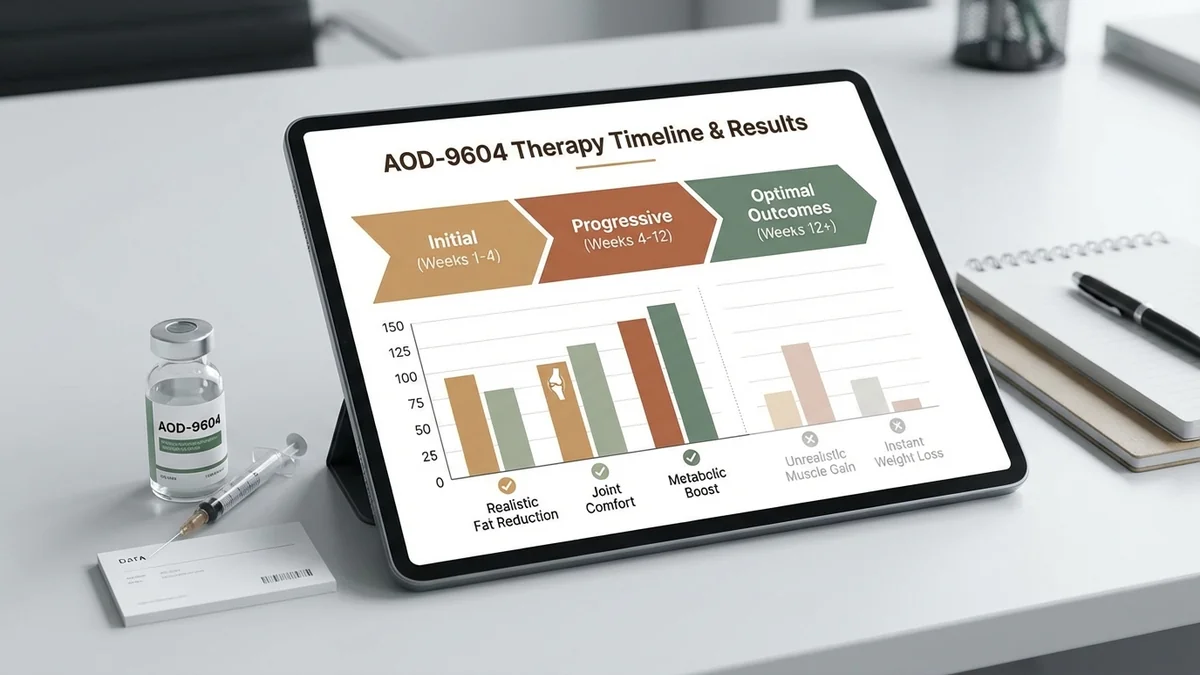
Week 1-2: Initial Period
Without published clinical data establishing AOD-9604's pharmacokinetic profile, the initial response timeline remains speculative. Typical peptide therapies targeting metabolic pathways require 2-4 weeks for receptor binding saturation and downstream signaling pathway activation[2]. During this period, measurable physiological changes are unlikely based on established peptide pharmacology principles.
Patients should not expect immediate metabolic effects during the first two weeks, as β-adrenergic and AMPK pathway modulation requires time for cellular adaptation. Unlike rapid-acting medications, peptide-based interventions typically demonstrate delayed onset due to their mechanism requiring protein synthesis and enzymatic cascade activation.
Week 3-4: Early Response
Standard metabolic peptides begin demonstrating measurable effects at 3-4 week intervals through established clinical trial protocols. However, AOD-9604's specific timeline lacks validation through controlled human studies. Preclinical models suggest potential metabolic parameter changes may become detectable at this timepoint, but extrapolation from animal studies to human responses requires caution[2].
The absence of published pharmacokinetic data prevents accurate prediction of therapeutic window establishment. Clinicians cannot reliably assess treatment response without established biomarkers or validated outcome measures specific to AOD-9604 therapy.
Month 2-3: Therapeutic Effect Builds
Established metabolic therapies typically reach therapeutic steady-state by 8-12 weeks of consistent administration. For comparison, semaglutide demonstrates progressive weight loss through 68 weeks in clinical trials, with most patients achieving meaningful response by 12-16 weeks[6]. AOD-9604's comparable timeline cannot be determined without completed Phase III studies.
The 8-12 week interval represents a critical assessment period for metabolic interventions, when treatment continuation decisions typically occur in clinical practice. Without established efficacy benchmarks, providers cannot apply evidence-based response criteria to AOD-9604 therapy.
Month 4-6: Full Effect
Long-term metabolic therapies often require 4-6 months for maximum therapeutic benefit realization. FDA-approved GLP-1 receptor agonists demonstrate continued efficacy improvement through 68-72 weeks in pivotal trials[5][6]. AOD-9604's long-term response profile remains undefined due to incomplete clinical development.
The absence of maintenance phase data prevents assessment of whether therapeutic effects plateau or continue improving beyond 6 months. This information gap complicates treatment planning and patient counseling regarding expected duration of therapy.
Beyond 6 Months
Durability of AOD-9604 effects lacks clinical validation through long-term follow-up studies. Established metabolic therapies demonstrate maintained efficacy through 2-year extension studies, with some patients achieving sustained benefits[5]. The peptide's long-term safety profile and efficacy maintenance cannot be assessed without appropriate clinical trial data.
Treatment discontinuation effects remain unknown, as withdrawal studies have not been conducted. This contrasts with approved therapies where cessation typically results in gradual return to baseline parameters over 12-24 weeks.
Results by Use Case
Metabolic Research Applications
AOD-9604's primary application remains confined to research settings investigating metabolic pathway modulation. Preclinical studies suggest potential effects on adipocyte differentiation and lipid metabolism through AMPK activation[2]. However, translation to therapeutic applications requires completion of Phase III clinical programs with defined primary endpoints.
Research protocols typically employ dosing ranges of 250-1000 mcg daily based on preclinical models, though optimal human dosing remains undetermined. The peptide's research utility centers on mechanistic pathway investigation rather than clinical therapeutic applications.
Investigational Metabolic Support
Some research protocols investigate AOD-9604's potential metabolic effects in controlled laboratory settings. These studies focus on cellular metabolism markers and enzymatic pathway activation rather than clinical outcomes[2]. The distinction between research investigation and therapeutic application remains critical for regulatory compliance.
Investigational use requires appropriate institutional oversight and cannot substitute for FDA-approved metabolic therapies with established clinical efficacy. Researchers must maintain clear boundaries between experimental investigation and therapeutic claims.
Factors That Affect Results
Dosing Protocol and Administration
Without established clinical dosing guidelines, AOD-9604 administration protocols vary significantly across research applications. Preclinical models suggest subcutaneous injection as the preferred route, with dosing frequencies ranging from daily to twice-daily administration[2]. However, optimal human dosing remains undetermined without completed dose-ranging studies.
Injection site rotation and proper storage at 2-8°C are standard requirements for peptide stability maintenance. The peptide's stability profile and reconstitution requirements follow typical lyophilized peptide protocols, though specific degradation kinetics have not been published.
Individual Physiological Variation
Metabolic peptide responses demonstrate significant individual variation based on baseline insulin sensitivity, body composition, and genetic polymorphisms affecting receptor expression. AOD-9604's response variability cannot be quantified without population-based clinical studies including diverse demographic groups.
Factors such as age, BMI, and concurrent medications may influence peptide pharmacokinetics and pharmacodynamics, but specific interactions remain unstudied. This contrasts with approved therapies where subgroup analyses identify response predictors.
Concurrent Lifestyle Interventions
Metabolic therapies typically demonstrate enhanced efficacy when combined with structured lifestyle interventions including dietary modification and exercise protocols. AOD-9604's interaction with lifestyle factors remains unstudied, preventing evidence-based recommendations for combination approaches.
Clinical trials of approved metabolic peptides consistently include lifestyle counseling components, with combination therapy showing superior outcomes compared to pharmacotherapy alone[5][6]. The absence of such data for AOD-9604 limits comprehensive treatment planning.
What Results Look Like in Practice
Clinical experience with AOD-9604 remains limited due to its research-only status and incomplete clinical development. Providers working with research protocols report variable responses, though systematic outcome tracking has not been published in peer-reviewed literature. The absence of validated assessment tools complicates objective response measurement.
Practical outcome assessment requires established biomarkers and clinical endpoints validated through controlled trials. Without these benchmarks, subjective reporting becomes the primary assessment method, introducing significant bias potential. This contrasts sharply with approved therapies where standardized outcome measures enable objective response evaluation.
The range of individual responses cannot be characterized without population-based data including responder analysis and effect size calculations. Anecdotal reports lack statistical power to establish meaningful response patterns or identify predictive factors for treatment success.
Results Compared to Alternatives
| Treatment | Typical Outcome | Timeline | Evidence Level | Key Study |
|---|---|---|---|---|
| AOD-9604 | Undetermined | Unknown | Phase IIa only | Not published |
| Semaglutide | 14.9% weight loss | 68 weeks | FDA-approved | STEP 1 (NCT03548935) |
| Tirzepatide | 22.5% weight loss | 72 weeks | FDA-approved | SURMOUNT-1 (NCT04184622) |
| Liraglutide | 8.0% weight loss | 56 weeks | FDA-approved | SCALE (NCT01272219) |
The comparison highlights AOD-9604's limited evidence base relative to established metabolic therapies. FDA-approved alternatives demonstrate consistent efficacy across large patient populations with well-defined safety profiles[5][6]. The absence of head-to-head comparison studies prevents direct efficacy assessment between AOD-9604 and approved alternatives.
Cost-effectiveness analysis cannot be performed without established clinical outcomes and treatment protocols. Approved therapies offer predictable treatment costs and insurance coverage options, while research peptides lack standardized pricing or reimbursement mechanisms.