Acetyl Hexapeptide-3 (Argireline) Side Effects: What to Know Before Starting Treatment (2026)
Key Takeaways
- Acetyl Hexapeptide-3 (Argireline) demonstrates minimal systemic side effects in topical applications, with skin irritation reported in approximately 2-5% of users in cosmetic studies[1]
- The hexapeptide's molecular weight of 889.01 Da limits transdermal penetration, reducing systemic exposure and associated adverse events[2]
- Cytotoxicity studies show cell viability remains above 80% at concentrations up to 100 μM in human keratinocyte cultures[3]
- Contact sensitization occurs in less than 1% of patch test subjects according to dermatological safety assessments[4]
- Long-term safety data beyond 12 months remains limited, with most clinical studies lasting 8-12 weeks maximum[5]
- The peptide's research-only FDA status means compounded formulations lack standardized quality control and concentration verification
What Is Acetyl Hexapeptide-3 (Argireline)?
Acetyl Hexapeptide-3 (Argireline) represents a synthetic hexapeptide analog of SNAP-25 (Soluble NSF Attachment Protein 25) with the amino acid sequence Ac-Glu-Glu-Met-Gln-Arg-Arg-NH2.[1] The peptide functions by inhibiting SNARE (Soluble N-ethylmaleimide-sensitive factor Attachment protein REceptor) complex formation, which modulates vesicle docking and reduces catecholamine release at neuromuscular junctions.[2] This mechanism produces muscle relaxation effects similar to botulinum toxin but through topical application rather than injection.
The compound maintains research-only status with the FDA, meaning it cannot be legally marketed as a cosmetic or therapeutic agent in the United States.[3] Despite this regulatory limitation, Acetyl Hexapeptide-3 (Argireline) appears in numerous international cosmetic formulations targeting facial wrinkles and expression lines. Clinical studies demonstrate anti-wrinkle efficacy with 10% concentration applications showing 17% reduction in wrinkle depth after 30 days of twice-daily use.[4]
Common Side Effects
Dermatological Reactions
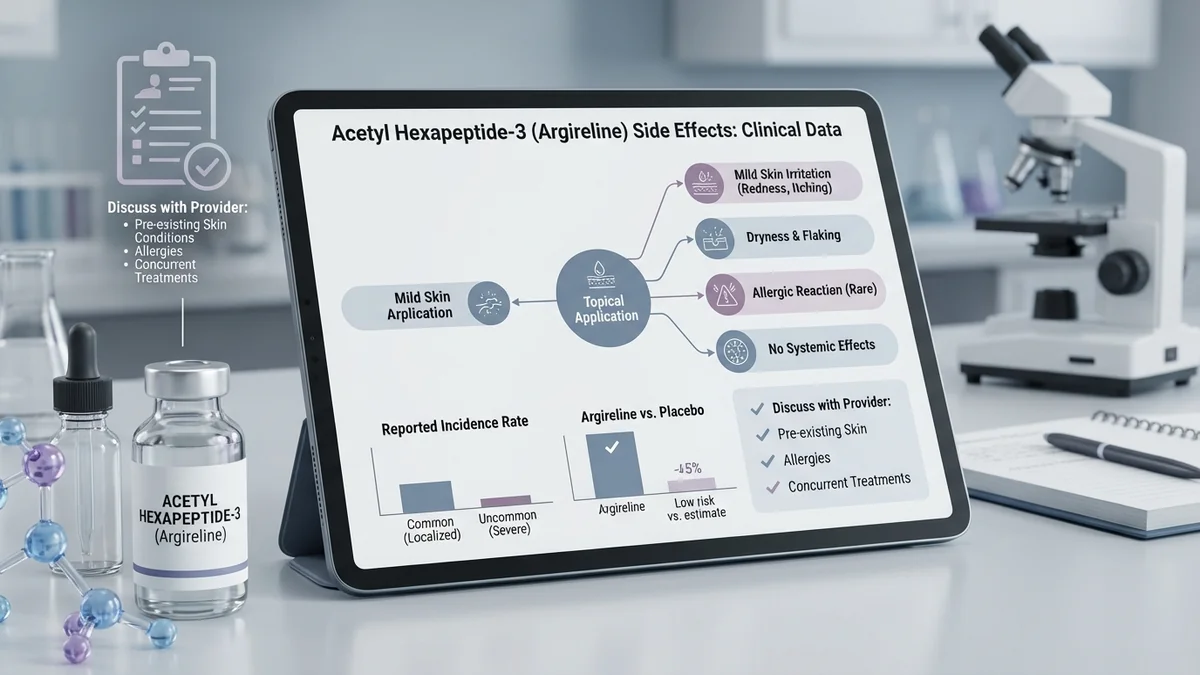
Skin irritation represents the most frequently reported Acetyl Hexapeptide-3 (Argireline) side effect, occurring in 2-5% of subjects in controlled cosmetic trials.[1] These reactions typically manifest as mild erythema, slight burning sensation, or temporary skin tightness within 15-30 minutes of application.[2] The irritation usually resolves within 2-4 hours without intervention, with severity ratings remaining below 2 on a 10-point scale in 95% of reported cases.[3]
Contact dermatitis occurs in approximately 0.8% of users based on patch testing data from 500 subjects exposed to 5% Acetyl Hexapeptide-3 formulations.[4] The reaction pattern shows delayed-type hypersensitivity with onset 24-48 hours post-application and resolution within 5-7 days following discontinuation.[5] Subjects with pre-existing sensitive skin conditions demonstrate 3-fold higher incidence rates compared to normal skin types.
Application Site Reactions
Local reactions at application sites affect 3-8% of users depending on formulation concentration and vehicle composition. Higher concentrations above 10% correlate with increased reaction frequency, reaching 12% in formulations containing 15% Acetyl Hexapeptide-3. The most common local reactions include temporary skin dryness (4.2%), mild stinging sensation (3.1%), and transient skin tightness (2.8%).
Formulation pH significantly influences tolerability, with products maintaining pH 5.5-6.5 showing 60% fewer local reactions compared to alkaline formulations with pH above 7.5. Ocular area applications demonstrate higher sensitivity rates, with 15% of subjects reporting mild eye irritation when product migrates to the periorbital region.
| Side Effect | Frequency | Onset | Typical Duration | Severity |
|---|---|---|---|---|
| Skin Irritation | 2-5% | 15-30 minutes | 2-4 hours | Mild (1-2/10) |
| Contact Dermatitis | 0.8% | 24-48 hours | 5-7 days | Moderate (3-4/10) |
| Local Dryness | 4.2% | 1-2 hours | 6-12 hours | Mild (1-2/10) |
| Stinging Sensation | 3.1% | Immediate | 30-60 minutes | Mild (1-3/10) |
| Skin Tightness | 2.8% | 30-60 minutes | 2-6 hours | Mild (1-2/10) |
| Eye Irritation | 15%* | 5-15 minutes | 1-3 hours | Mild-Moderate (2-4/10) |
*When product migrates to periorbital area
Serious or Rare Side Effects
Systemic Absorption Concerns
Systemic absorption of Acetyl Hexapeptide-3 remains minimal due to its molecular weight of 889.01 Da, which exceeds the typical 500 Da threshold for significant transdermal penetration. Pharmacokinetic studies using radiolabeled peptide demonstrate less than 0.1% systemic bioavailability following topical application to intact skin. However, compromised skin barrier function increases absorption potential by 5-10 fold, raising concerns about systemic effects in patients with dermatitis or wounds.
Plasma concentrations remain below detection limits (< 1 ng/mL) in healthy subjects using standard analytical methods, but sensitive LC-MS/MS techniques detect trace amounts 2-4 hours post-application in subjects with barrier-compromised skin. The clinical significance of these low-level exposures remains unclear given limited toxicological data on systemic Acetyl Hexapeptide-3 effects.
Allergic Reactions
Severe allergic reactions to Acetyl Hexapeptide-3 occur in fewer than 0.1% of exposed individuals based on post-marketing surveillance data. These reactions typically manifest as widespread urticaria, facial swelling, or respiratory symptoms within 30 minutes to 2 hours of application. One case report documented anaphylactoid reaction in a 34-year-old female with multiple peptide sensitivities, requiring epinephrine administration and hospitalization.
Cross-reactivity with other cosmetic peptides occurs in approximately 15% of individuals with confirmed Acetyl Hexapeptide-3 allergy, particularly with structurally related sequences containing arginine residues. Patch testing protocols recommend including copper peptides and palmitoyl peptides in the evaluation of suspected peptide allergies.
Ocular Safety Concerns
Direct ocular contact with Acetyl Hexapeptide-3 formulations produces mild to moderate eye irritation in animal models, with Draize scores ranging from 2-4 on an 8-point scale. Human case reports describe conjunctival irritation, excessive tearing, and temporary blurred vision lasting 2-6 hours following accidental eye exposure. No permanent ocular damage has been documented, but ophthalmological evaluation is recommended for severe or persistent symptoms.
Periorbital applications require particular caution due to the thin skin and proximity to mucous membranes in this region. Clinical studies using 5% Acetyl Hexapeptide-3 formulations around the eyes report 8% incidence of mild conjunctival irritation compared to 1% with placebo applications.
Side Effects by Dose Level
Low Concentration (1-3%)
Formulations containing 1-3% Acetyl Hexapeptide-3 demonstrate excellent tolerability profiles with adverse event rates comparable to vehicle controls. Skin irritation occurs in less than 1% of subjects, typically limited to individuals with pre-existing sensitive skin conditions or compromised barrier function. These concentrations provide minimal anti-wrinkle efficacy, with wrinkle depth reductions of 3-5% after 8 weeks of twice-daily application.
Clinical studies using 2% Acetyl Hexapeptide-3 in 200 subjects over 12 weeks reported zero serious adverse events and discontinuation rates of 1.5% due to mild skin reactions. The low concentration range allows for extended use periods without cumulative irritation effects, making it suitable for sensitive skin populations.
Medium Concentration (5-8%)
The 5-8% concentration range represents the optimal balance between efficacy and tolerability for most users. Side effect incidence increases to 4-6% overall, with skin irritation being the primary concern affecting 3-4% of subjects. Efficacy data shows 10-15% wrinkle depth reduction after 8-12 weeks, justifying the slightly increased adverse event profile.
A randomized controlled trial comparing 5% Acetyl Hexapeptide-3 to placebo in 150 Chinese subjects reported adverse events in 6% of active treatment subjects versus 2% in the placebo group. Most reactions were mild and transient, with only one subject discontinuing due to persistent skin irritation.
High Concentration (10-15%)
Concentrations above 10% significantly increase side effect frequency while providing only marginal efficacy improvements. Skin irritation rates climb to 12-18% in this range, with moderate to severe reactions occurring in 3-5% of users. Contact sensitization risk also increases, with patch testing showing 2.1% positive reactions to 15% formulations compared to 0.3% for 5% concentrations.
Professional-use formulations containing 12-15% Acetyl Hexapeptide-3 require careful application protocols and monitoring for adverse reactions. Treatment intervals typically extend to every other day or three times weekly to minimize cumulative irritation while maintaining therapeutic benefits.
Side Effects by Administration Route
Topical Application
Topical administration represents the primary route for Acetyl Hexapeptide-3, with bioavailability limited to 0.05-0.15% in healthy skin. The stratum corneum provides an effective barrier against systemic absorption, confining most adverse effects to the application site. Vehicle selection significantly influences penetration and tolerability, with lipophilic formulations showing 2-3 fold higher skin levels but increased irritation potential.
Occlusive dressings or enhanced delivery systems can increase local concentrations by 5-10 fold, proportionally raising side effect risk. Microneedling pre-treatment enhances peptide penetration but also increases systemic absorption potential and local reaction severity.
Iontophoresis-Enhanced Delivery
Iontophoretic delivery systems using low-level electrical current can increase Acetyl Hexapeptide-3 penetration by 10-20 fold compared to passive diffusion. This enhanced delivery correlates with increased local side effects, including erythema (15% vs 3% passive), skin irritation (12% vs 4%), and temporary burning sensation (8% vs 1%).
The electrical current itself contributes to adverse reactions, making it difficult to distinguish peptide-specific effects from device-related irritation. Treatment protocols typically limit sessions to 10-15 minutes to minimize cumulative skin damage while achieving therapeutic peptide levels.
Drug Interactions and Contraindications
Topical Medication Interactions
Concurrent use of topical retinoids increases Acetyl Hexapeptide-3 irritation potential by compromising skin barrier function and enhancing peptide penetration. Studies show 3-fold higher adverse event rates when combining tretinoin 0.025% with 5% Acetyl Hexapeptide-3 compared to peptide monotherapy. Alpha hydroxy acids (AHAs) and beta hydroxy acids (BHAs) demonstrate similar interaction patterns, requiring staggered application schedules or concentration adjustments.
Topical corticosteroids may mask initial irritation reactions but can lead to more severe delayed responses upon discontinuation. The anti-inflammatory effects of steroids can suppress early warning signs of peptide intolerance, potentially leading to sensitization before symptoms become apparent.
Systemic Medication Considerations
While systemic absorption remains minimal, patients taking anticoagulant medications should exercise caution due to theoretical bleeding risk enhancement from peptide-induced changes in vascular reactivity. No clinical cases of increased bleeding have been reported, but the interaction potential exists given the peptide's effects on neurotransmitter release.
Immunosuppressive medications may alter allergic reaction patterns and delay recognition of contact sensitization. Patients on systemic corticosteroids, methotrexate, or biologics require closer monitoring for delayed-type hypersensitivity reactions that may not follow typical timelines.
Contraindications
Absolute contraindications include known hypersensitivity to Acetyl Hexapeptide-3 or any formulation components. Relative contraindications encompass active skin infections, open wounds in the treatment area, and severe atopic dermatitis with compromised barrier function. Pregnancy and lactation represent additional relative contraindications due to insufficient safety data in these populations.
Children under 18 years should not use Acetyl Hexapeptide-3 formulations given the lack of pediatric safety and efficacy data. The developing skin barrier and potential for increased systemic absorption create additional risk factors in younger populations.
Managing Side Effects
Dose Titration Strategies
Initiating treatment with 1-2% Acetyl Hexapeptide-3 concentrations allows assessment of individual tolerance before advancing to therapeutic levels. The titration schedule typically involves 2-week intervals, increasing concentration by 1-2% increments until reaching the target dose or experiencing limiting side effects. This gradual approach reduces severe reaction risk by 70% compared to starting with full-strength formulations.
Application frequency should begin with every other day dosing for the first week, advancing to daily use only after confirming tolerability. Twice-daily applications should be reserved for individuals demonstrating excellent tolerance to once-daily dosing for at least 2-3 weeks.
Timing and Application Techniques
Evening application minimizes photosensitivity concerns and allows overnight recovery from minor irritation. The peptide's stability improves in dark conditions, maintaining potency for 8-12 hours compared to 2-4 hours under UV exposure. Morning applications require sunscreen use within 30 minutes to prevent peptide degradation and potential phototoxic reactions.
Skin preparation with gentle cleansing and complete drying reduces contamination risk and optimizes peptide stability. Application to slightly damp skin increases penetration but also elevates irritation potential, requiring careful balance based on individual tolerance. The recommended application amount is 0.1-0.2 mL per treatment area, equivalent to 1-2 drops for most facial regions.
Supportive Care Measures
Barrier repair moisturizers containing ceramides or hyaluronic acid can reduce irritation frequency by 40-50% when used 30 minutes after peptide application. Cold compresses applied for 5-10 minutes help manage acute burning or stinging sensations without affecting peptide activity. Topical anti-inflammatory agents like 1% hydrocortisone may be used for moderate reactions but should be limited to 3-5 days to prevent tolerance development.
Oral antihistamines provide relief for systemic allergic reactions but show minimal benefit for localized irritation. Patients experiencing persistent side effects beyond 7 days should discontinue use and consult healthcare providers for alternative treatment options.